













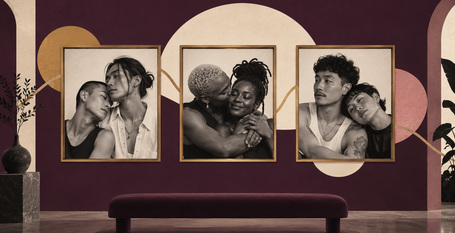
A portrait can be intimate. A protest photograph can be public. In Sunil Gupta’s “Pretended” Family Relationships, the two are brought together, with a poem making a third voice in the conversation.
Gupta describes the construction on his own website: a portrait of an unnamed couple, poetry by his then partner Stephen Dodd, and part of an image made at a London demonstration against Clause 28. The series responds to the political language that dismissed queer relationships as pretended families. The work’s title carries that language back into the picture.
The series is included in Staging Resistance at Hales in London, open until 17 October 2026. The exhibition brings Gupta together with Tessa Boffin and Rotimi Fani-Kayode, looking at their photography in the context of 1980s London. This is an introduction based on the artists’ and galleries’ published material, rather than an account of a visit.
Hales presents three distinct bodies of work. Alongside Gupta’s portraits are Fani-Kayode’s Bodies of Experience, which the gallery connects to race, sexuality, diaspora and Yoruba spirituality, and Boffin’s Angelic Rebels: Lesbians and Safer Sex. The pairing asks viewers to consider different ways of making queer lives visible, rather than search for a single photographic style.
For Gupta, born in New Delhi and now based in London, migration is part of the wider frame. A separate survey, Life with a Camera, 1970 – Now, is currently at Kettle’s Yard in Cambridge until 31 January 2027. The institution describes more than 130 works across a life moving between Delhi, Montreal, New York and London.
Its selection includes Dissent and Desire, made with Charan Singh in 2015 and focused on LGBTQ+ life in Delhi. That offers another route into the work for audiences interested in the relationships between Asian queer lives and the diaspora.
One question to bring to these projects is what makes a photograph feel like evidence of belonging. Is it the people, the room they occupy, the accompanying words, or the decision to give an ordinary relationship sustained attention?
The London show closes next Saturday; the Cambridge survey continues into the new year. Their official pages provide visitor information. The images and series descriptions are also starting points for a conversation that does not depend on being able to travel.
What would you want a photograph of queer family life to preserve for someone looking at it in forty years?


 列印版本
列印版本

 RSS Feed: 時尚娛樂


讀者回應
搶先發表第一個回應吧!
請先登入再使用此功能。